

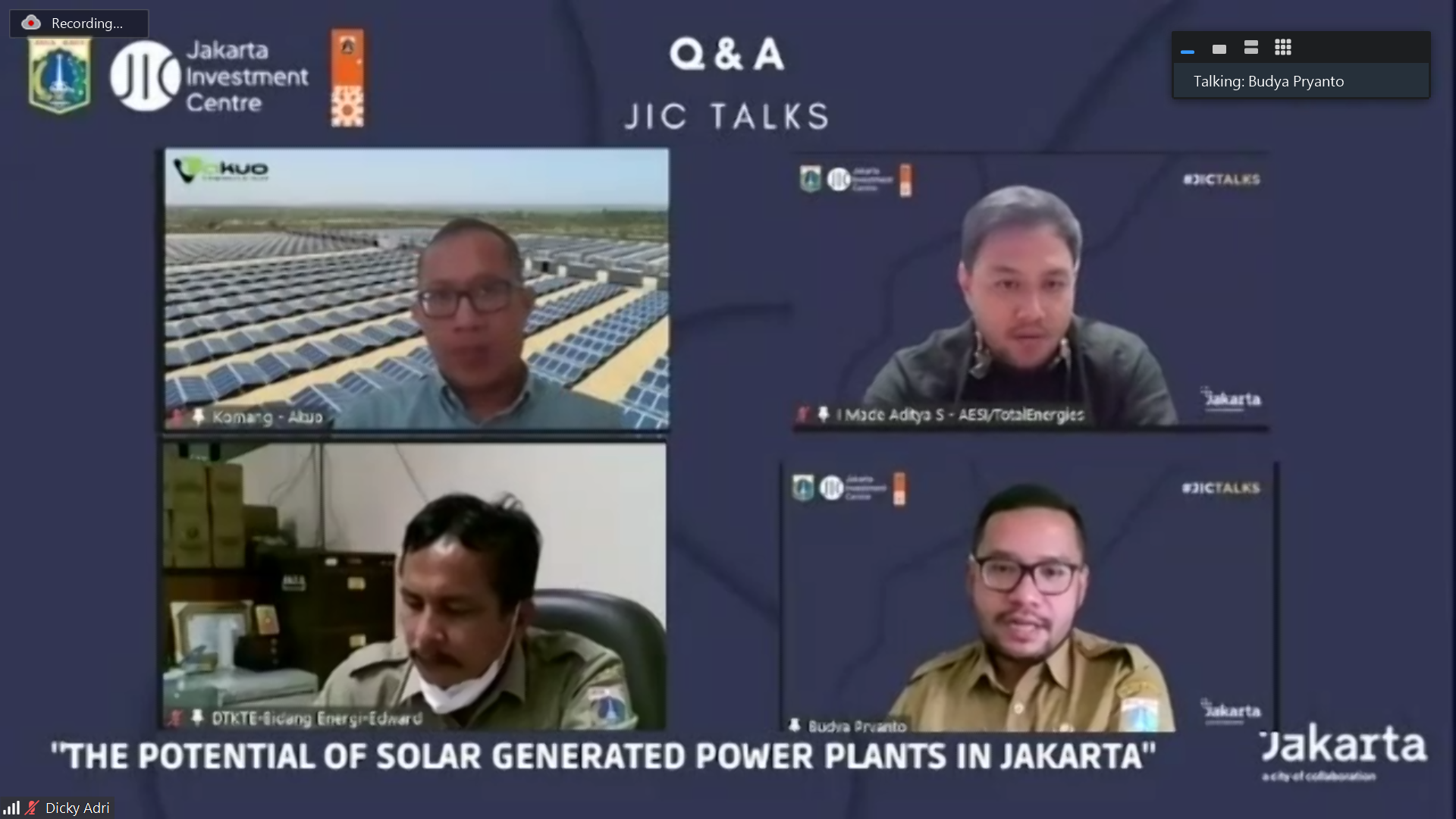
Jakarta Capital City Government is currently pushing the use of new and renewable energy (EBT) to reduce 30% of GHG emissions by 2030. One way to accelerate this is by developing solar power plants (PLTS). In line with this, the provincial government encourages investment in its development. To facilitate discussion among related stakeholders, Jakarta Investment Centre (JIC) held the second JIC Talks in 2022 with a topic on “The Potential of Solar Generated Power Plants in Jakarta” virtually on Tuesday, March 22nd.
The lively discussion was facilitated by Mr. Edward Napitulu as Head of the Energy Division of the Department for Manpower, Transmigration, and Energy Jakarta Capital City Government; Mr. I Made Aditya Suryawidya as General Secretary of the Indonesian Solar Energy Association (AESI) & Senior Business Developer-Renewables of TotalEnergies; and Mr. I Komang Adi Awantara as Head of Solutions/Business Development Lead of PT. Akuo Energy Indonesia.
Around 110 participants from related industries joined the discussion that was moderated by Mr. Budya Budya Pryanto Putra as Caretaker Head of Jakarta Investment Centre, Department for Investment and Integrated One Stop Services, Jakarta Capital City Government.
Head of the Energy Division of the Department for Manpower, Transmigration, and Energy Jakarta Capital City Government Mr. Edward Napitupulu said that Jakarta is estimated to produce 116,910,000 tons of CO2 in 2030. To reduce this huge emission, the Jakarta Capital City Government in compliance with The Paris Agreement is targeting a 30% emission reduction value of 35,673,000 tons of CO2 (equivalent to 43,663,400 MWh) in 2030. To achieve this, the government is initiating green transformation across the city. One of which is accelerating the implementation of the Regional Climate-Resilient Low Carbon Development Plan in accordance with the Governor's Regulation No. 90 of 2021.
For this reason, the government aims to implement around 23 MW of solar power plants (PLTS) in DKI Jakarta in 2030. All related stakeholders including private sectors and related institutions are invited to participate in putting this policy into realization. “This is actually our main important goal. Not only from the government sector but also the wider community, including related stakeholders,” he said.
Among other applications, the solar power plants industry is now developing in the direction of rooftop solar power grid (PLTS Atap) which tends to be simpler compared to the other resources in its application for a city scope.
As part of the government plan to accelerate rooftop solar power grid development, a number of incentives have been issued through the Energy and Mineral Resources Ministerial Regulation No.26/2021. The regulation increases the electricity export provisions to the PLN grid from 65% to 100%. In addition, the accumulated excess difference in bills is omitted, extended from 3 months to 6 months. Lastly, rooftop solar power grid application is shortened to 12 days (with sales and purchase agreement/PJBL) and 5 days (without PJBL).

According to Mr. Edward, several things can be done to utilize Renewable Energy development in order to achieve the target of the New Renewable Energy (EBT) mix of the Jakarta Capital City Government in the Regional Medium-Term Development Plan 2017-2022. These include converting transportation from fuel to electric vehicles, conducting audits of energy in government buildings, as well as preparing electric vehicle facilities and infrastructure.
Mr. I Made Aditya Suryawidya as General Secretary of the Indonesian Solar Energy Association (AESI) & Senior Business Developer-Renewables of TotalEnergies added that a detailed large-scale solar technical potential mapping, including network and storage system study, is necessary to be an input for Indonesia's electricity system planning that is more focused on renewable energy.
Meanwhile, Mr. Komang Adi Awantara as the Head of Solutions/Business Development Lead of PT. Akuo Energy Indonesia said that along with the increase in electricity prices, an increase in the green lifestyles trend will further increase the potential for solar PV. Aside from that, the decrease in the electricity price from solar PV compared to coal will even further boost solar PV development. Therefore, regulation, instruction, provided incentives, and cooperation with the private sector are needed.
He said that the solar PV ecosystem in Indonesia has been well-developed in terms of investment, economy, user, and government support. “So actually all of the elements to build solar PV have been formed. Now, we just have to find out more information and move in action independently to contribute to reducing greenhouse gas emissions and implementing renewable energy,” he said.
To conclude, Jakarta has a fairly high potential for solar energy. Participation and collaboration with various parties, especially financial institutions and the community, are important to increase the use of renewable energy in Jakarta. The ability of the community to produce their own electricity, both communally and individually, will help create sustainable energy security and create an independent mentality in its citizens. Jakarta Capital City Government is open to various opportunities for investors and project owners to develop solar PV in the future.